Souped Up Special
From XO Autosport Magazine vol.42 - 2000
🇹🇭 Thailand
Text by: Olar Luanpreeda, Krit Supakarn
Photo: Narong Harisdeekul
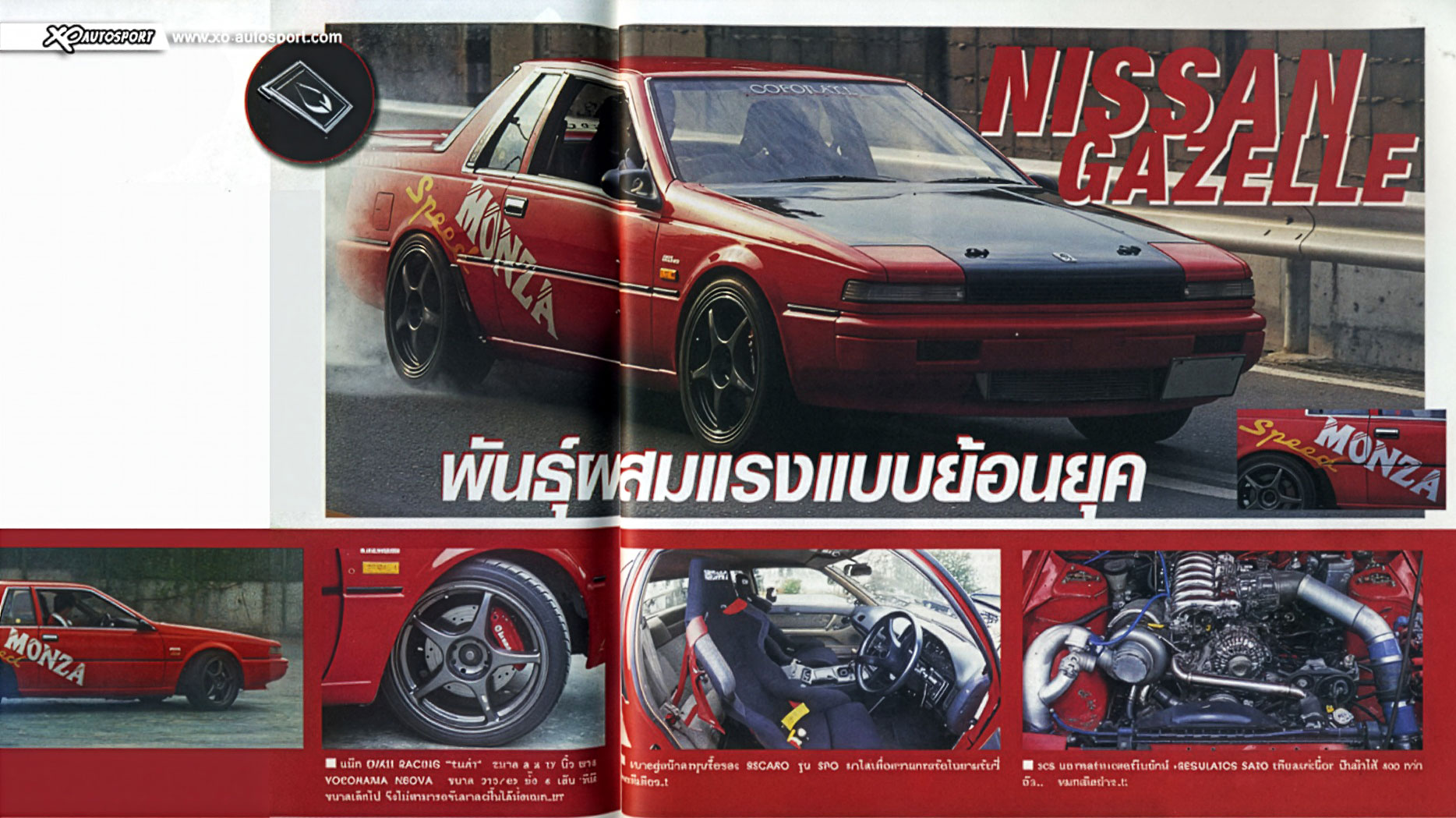
Nissan Gazelle - Retro Hybrid Breed
In the 2000s, “cross-breed” engine swaps were incredibly popular. This was perhaps due to insufficient engine power for some cars, but nothing compares to the thrill of performance driven by speed enthusiasts, regardless of the car's condition. This particular car, an older 1980s model, isn't just any old, dilapidated vehicle; its extraordinary feature lies in its “rotary engine”, delivering exhilarating acceleration and a breathtaking sound. The engine's tone is sweet, similar to a six-cylinder, but far more aggressive, especially at idle, where it “sobs…!” It's a modified “3-rotor” engine, but with just a few modifications that left our team speechless! Want to know more? Keep reading!
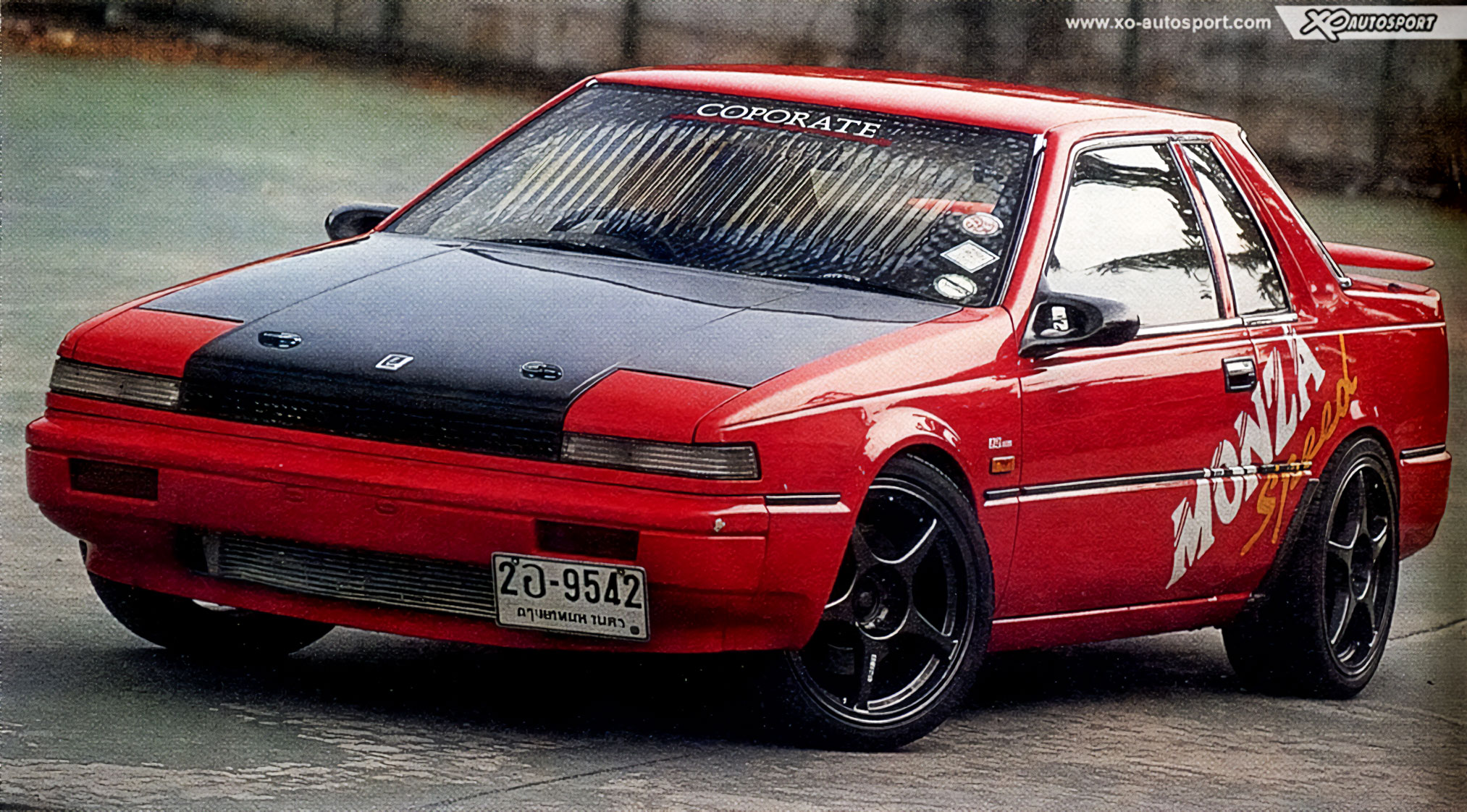
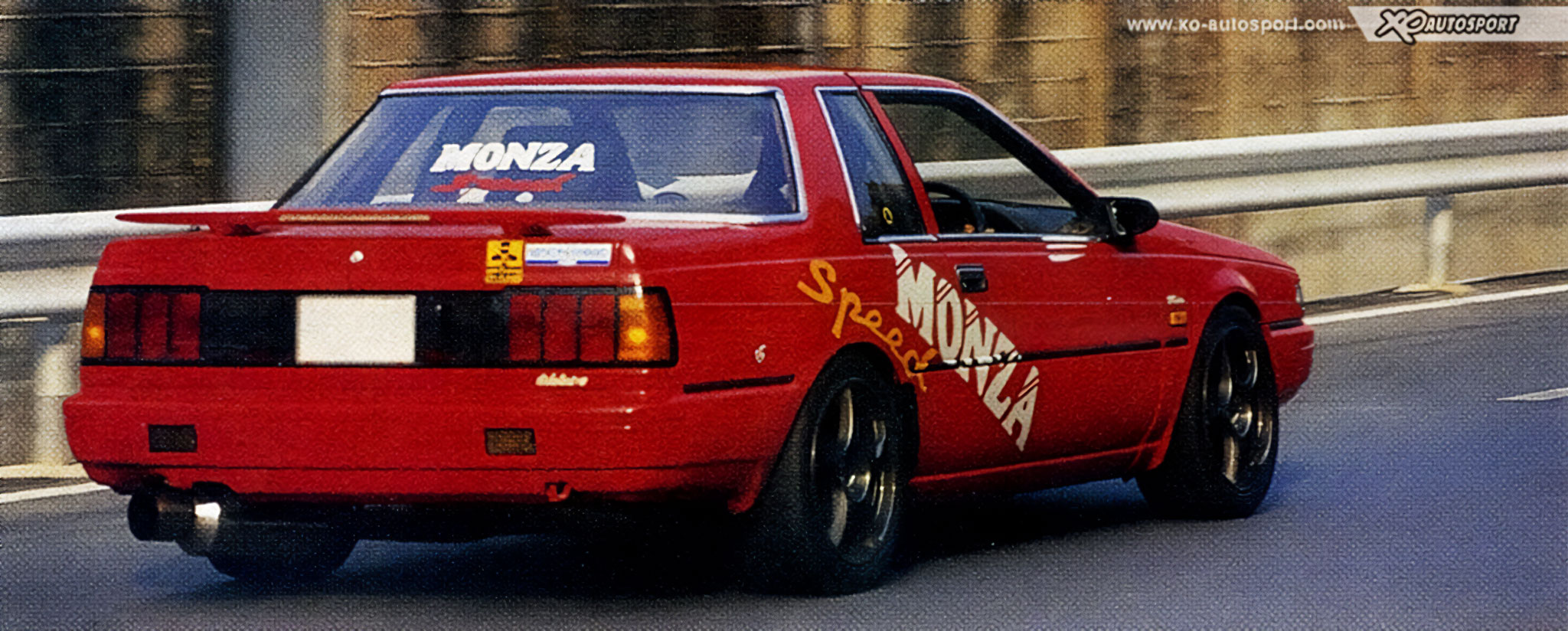
The body is a 1985 Nissan GAZELLE, chassis code S12, which was sold for scrap metal, while the original CA-18 DET engine was disposed of as “scrap metal.”
Many readers may not be familiar with the “Gazelle” because it's a classic model from the era when the last rear-wheel drive Corolla KE-70 was still relatively new and modern-looking. Going into its history would take up too much space, so let's just say it's part of the S12 family, produced around 1985. While the Silvia had a Liftback rear end, the Nissan Gazelle was a coupe, similar to the Corolla Liftback and the Trueno AE86. Its original engine was the CA-18 Det, producing around 145 horsepower. Not many were imported into Thailand back then; most cars of that era were the Supra with the pop-up headlights and the 7-M Turbo engine.
This car belonged to Mana Pornsiricherd (at that time, he was considered a successful and quite famous young racer). A chip off the old block, heir to “Nang Modify”, a prominent figure in motorcycle modification, but he didn't pursue motorcycle racing, opting instead for go-karts and cars (though his father was worried and didn't want him to race motorcycles). This GAZELLE was originally owned by his father's friend. When Mana saw it, he liked it and asked his father to buy it for him. He then had the engine swapped to a Rotary 13B Turbo at Monza Garage, Ladprao 87. Since then, the car has been continuously maintained by Monza Garage.
…After using the 13B engine for quite some time, to the point where I'd written about it on the street and many racers recognized this car — I'd pushed it to its limits until they were bored! — and getting used to its power, I started a “rebuild” project. After asking myself if I still loved “rotary” engines, I focused on the most powerful engine in the family: the Rotary 20B, originally from the Mazda COSMO, specifying 280 horsepower. Ultimately, I had to get it to satisfy my craving.
The engine itself doesn't have much modification; just “port polishing”. The heart of the power comes from the turbocharger, a “modified” formula from Mechanic Tee at the garage.
Monza
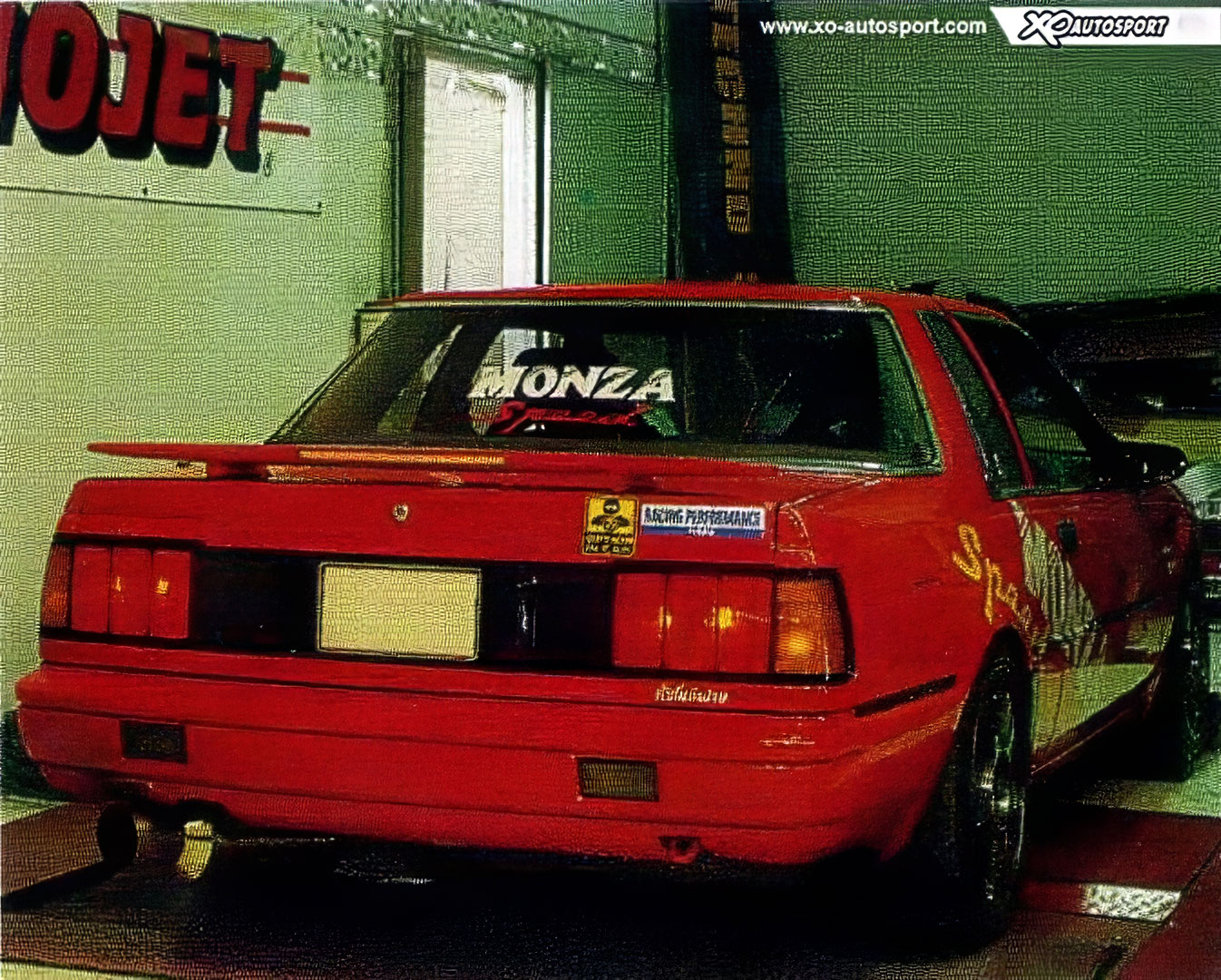
It can be said that Dee Monza has been taking care of this car since it was in its “embryonic” state, or rather, as a 13BT engine. Regarding the engine itself, Dee hasn't touched much, keeping it standard. The only additions are polishing the intake and exhaust ports. He's also removed the AC compressor and power steering pump to reduce the load on the engine. This means it's not practical for daily use; it'll probably just be used for modifications. The only other change is replacing the spark plugs with NGK #10.
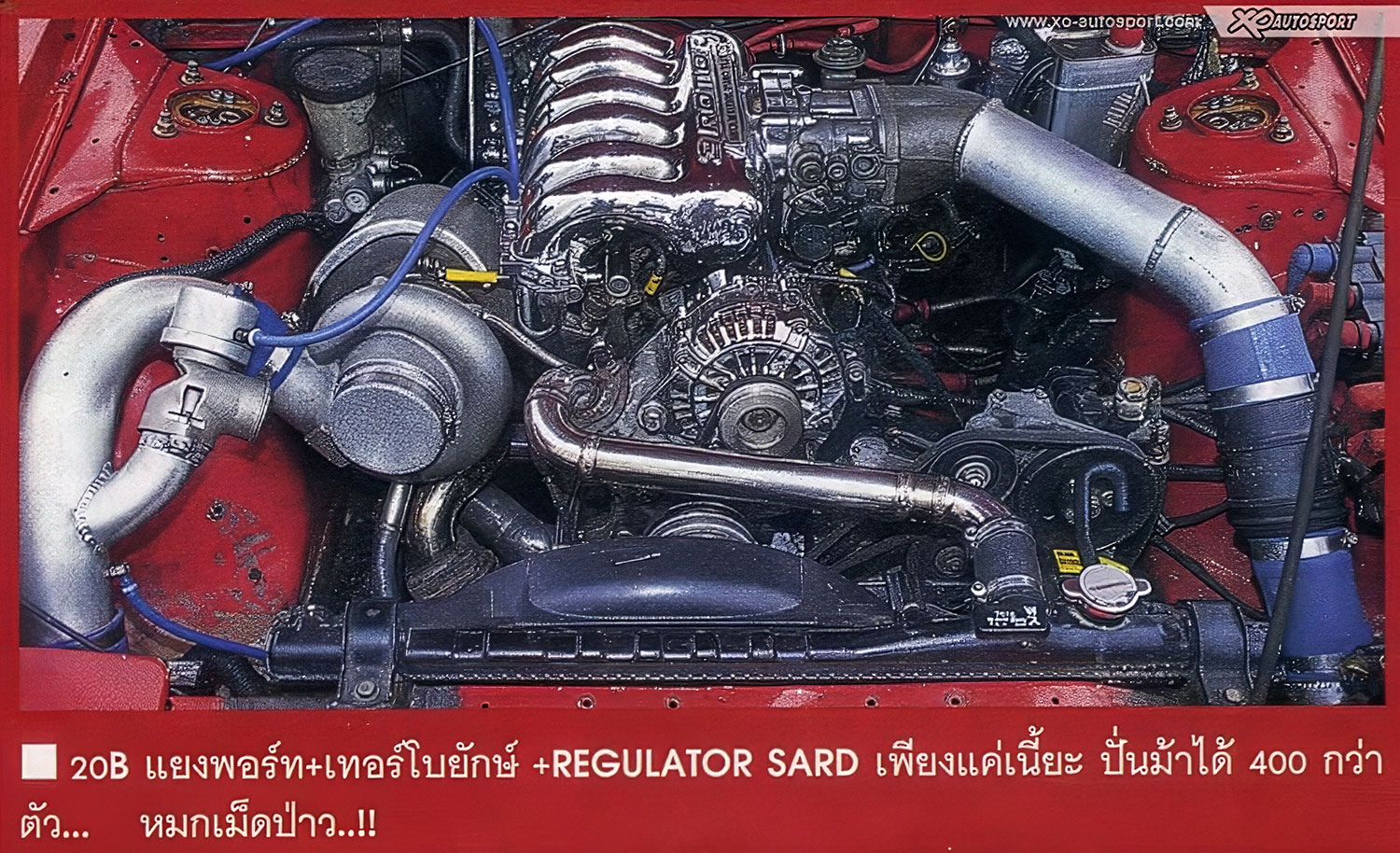
A ported 20B engine + a giant turbocharger + a SARD regulator – that's all it takes to produce over 400 horsepower… Is this a secret?!
The heart of this powertrain is the TD-08 turbocharger, but it's been modified for maximum performance according to “Tee Monza's” formula.
Outwardly, it looks like an ordinary turbocharger, but inside, it's “hidden gems.” The turbocharger impeller has been replaced with one from a large truck, approximately 2-3 mm larger than standard, similar in size to Greddy's T88. The turbo housing has been modified with re-welded, smaller ports to channel exhaust gases faster into the turbine, significantly reducing turbo lag. The intercooler has been replaced with an HKS unit to cool the intake air before it enters the combustion chamber, with intercooler piping done by Fighter. A Greddy blow-off valve controls excess intake air flow during throttle release, and the HKS GT wastegate, which regulates boost pressure to the set level, is also included.
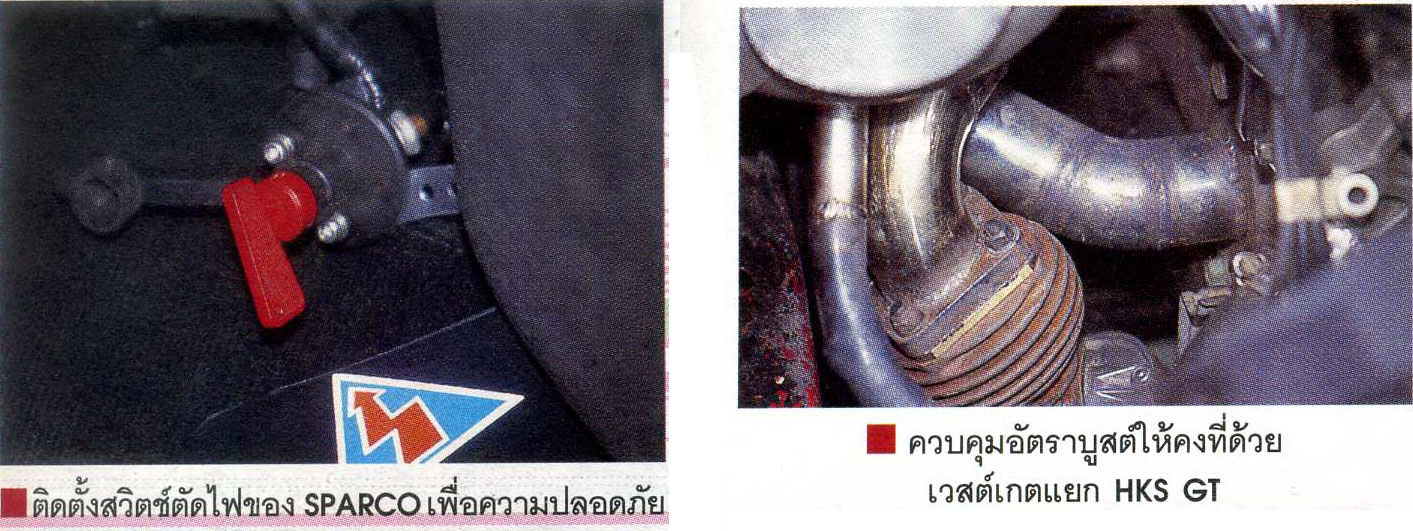
Left: Install a SPARCO circuit breaker for safety. / Right: Keep the boost rate constant. Wastegate HKS GT Split.
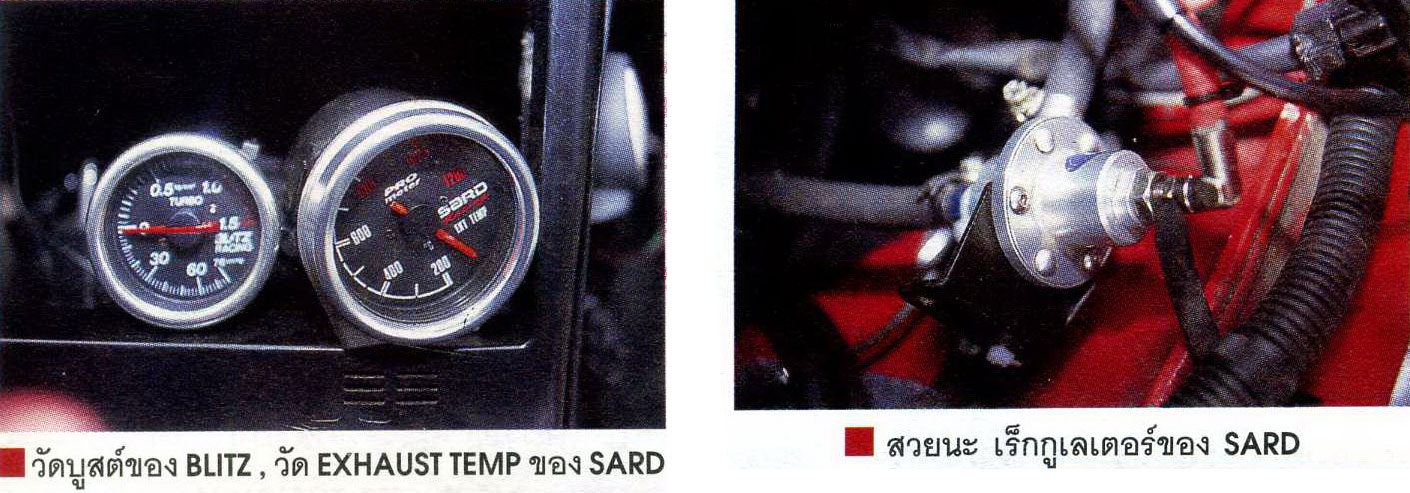
Left: BLITZ boost gauge, SARD exhaust temperature gauge. / Right: That's a nice SARD regulator.
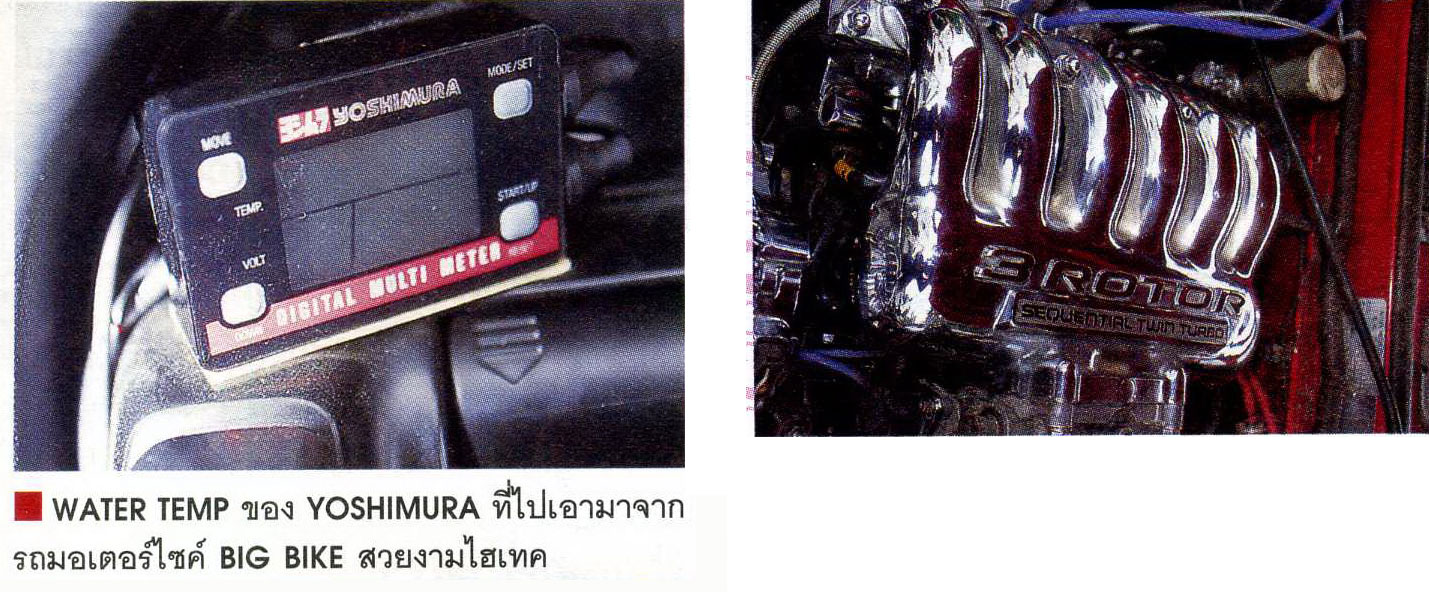
Left: Yoshimura's water temperature reading was taken from a beautiful, high-tech big bike.
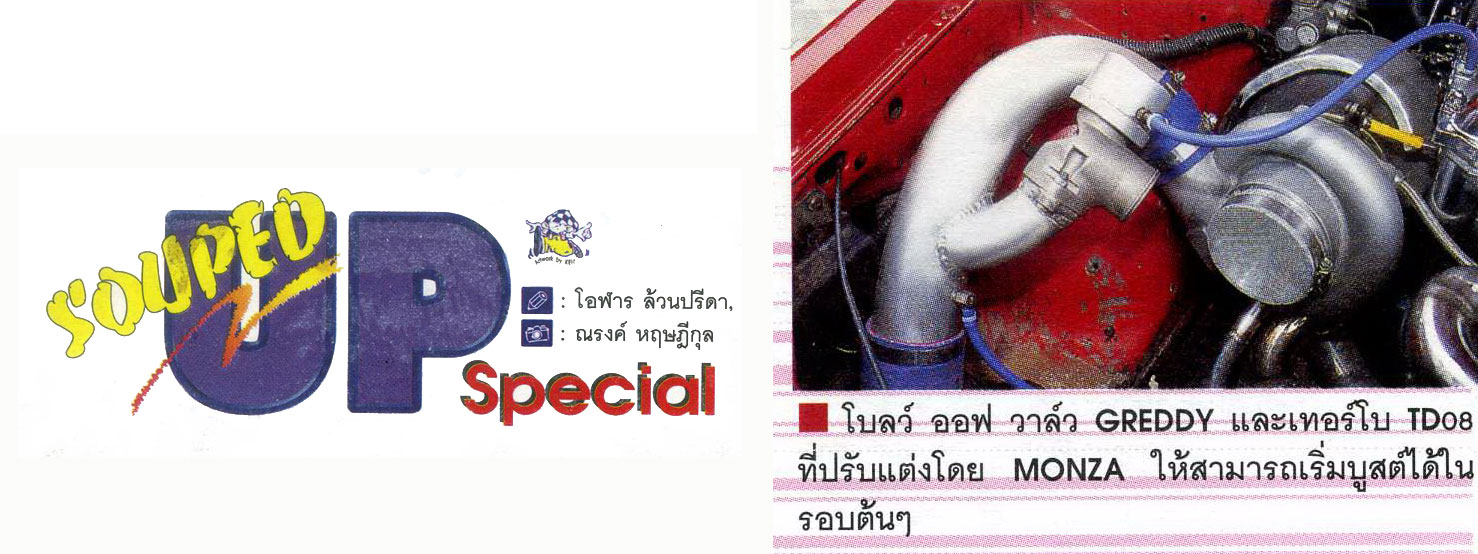
Right: The GREDDY blow-off valve and MONZA-tuned TD08 turbocharger allow for boost to start at low RPM's.
The fuel injection system still relies on a regulator because it's still using a standard ECU since the engine has just been replaced.
The test drive at Ray in early March 2000 still used the standard boost pressure of 0.8 bar because the fuel system had not yet been modified and no “aftermarket injectors” were used. The ECU was also standard. The reason for this was the team's constant urging to photograph it for the magazine. Too much boost would just damage the engine. However, it's expected to be more refined in a while, as we're waiting for a performance ECU and larger injectors. Initially, we used a SARD regulator to adjust the fuel delivery, and the fuel pumps were two Skineline R32 pumps located in the fuel tank. “That's enough for now!”
As for the cooling system, the owner modified it with a two-channel radiator and a large evaporative cooling fan from a 2.JZ-GTE engine, along with a Mazda Speed 13-pressure radiator cap. These modifications significantly reduce overheating during operation.
The transmission system has been improved to handle the increased engine speed. It features a hybrid gear system with slightly closer gear ratios.
Since the 20B engine only comes with an automatic transmission, which might not be able to handle this much power, and an automatic transmission wouldn't provide the exhilarating driving experience for a skilled driver like Khun Nueng, they decided to “merge” the tier gears from the 13B engine. Since the transmission was already swapped out, they decided to make the gear ratios even more aggressive using a special gear modification formula developed by Mechanic Tee. They used a hybrid transmission from the 13BT FC and FD engines. The FC transmission has relatively close gear ratios in gears 1-3, and less so in gears 4-5. The FD transmission has even closer ratios in gears 1-3 and even closer in gears 4-5. Mechanic Tee modified it to use gears 1-3 from the FC and gears 4-5 from the FD, by removing the counterweights from the main gear shaft of the FC transmission (which didn't have counterweights anyway). After that, to prevent clutch slippage (due to the high friction on the engine), further modifications were made. So, I had to replace the clutch assembly, including the cover and flywheel, with OS GIKEN parts for peace of mind. As for the “differential gear,” it has a 4.1 ratio borrowed from the Skyline R32.
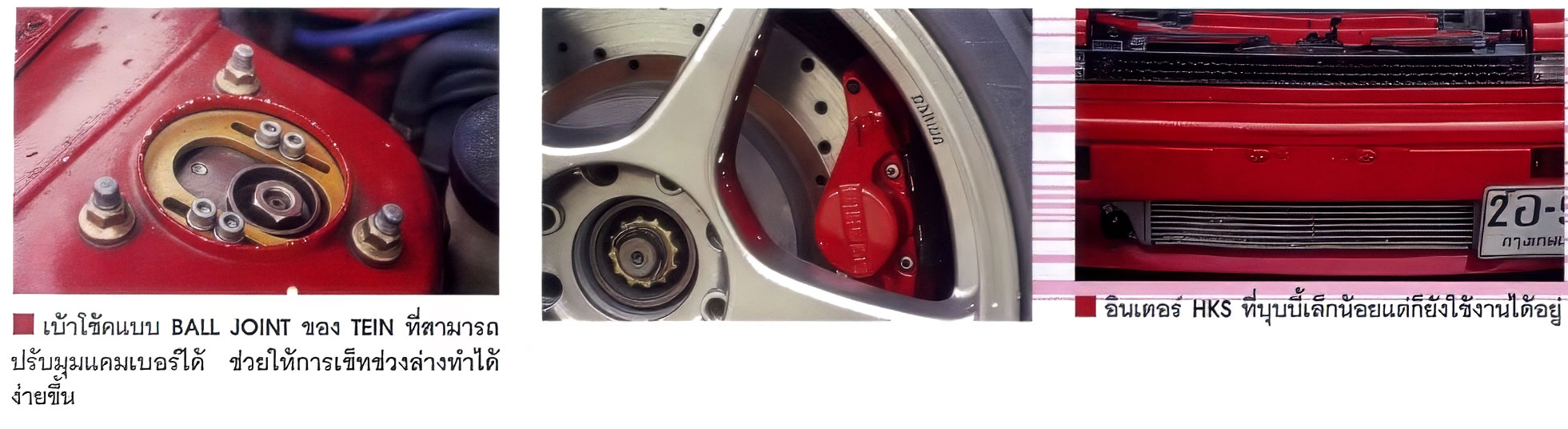
Left: TEIN's ball joint shock mounts, which allow for adjustable camber angles, make suspension tuning easier. / Right: The HKS intercooler is slightly dented but still usable.

Left: The entire front and rear brake assembly from an R32 GT-R is included. / Right: The appearance of the NISSAN GAZELLE (S12) bears a striking resemblance to the TOYOTA COROLLA (AE86) TRUENO.
The front suspension was swapped with parts from a 200SX, while the rear was changed from a solid axle to an independent suspension. The TEIN suspension kit also provides improved handling and confidence.
Suspecting that front suspension parts would be hard to find, Monza Garage decided to do a complete conversion. They replaced the front axle and steering rack with those from a Nissan 200SX. As for the rear suspension, which originally used a solid axle with shock absorbers, they replaced it with an R32 rear axle assembly, providing an independent rear suspension system. Furthermore, they enhanced performance with gas-filled coilover struts and Tein springs, which offer 21 levels of stiffness adjustment at the top of the shock absorbers. With this setup, you can be confident that you won't need to ease off the accelerator when cornering.
The Skyline R32's four-wheel disc brakes provide a “decisive” stopping power.
No workshop that modifies a car would neglect the brakes. Since this GAZELLE already had its suspension completely replaced, they opted for a brake kit from the same family. Because the differential and rear brakes were from an R32, they also installed the front brake discs and calipers from a Skyline R32. Finished off with Endless brake pads. Now, no more needing to rely on lampposts for sudden stops!
The wheels and tires are so small.
All four tires are Yokohama NEOVA size 215/40, and I wondered if such a powerful engine could handle it! I was confused. But Khun Nueng just said, “Just let it crawl, man!” Since we couldn't find replacement tires yet, we had to use these. I really wanted to ride along and see a driver of this caliber demonstrate the power, but I was still a little hesitant. Before that, we went to the Dyno. Now it's time to prove whether it's really that powerful!
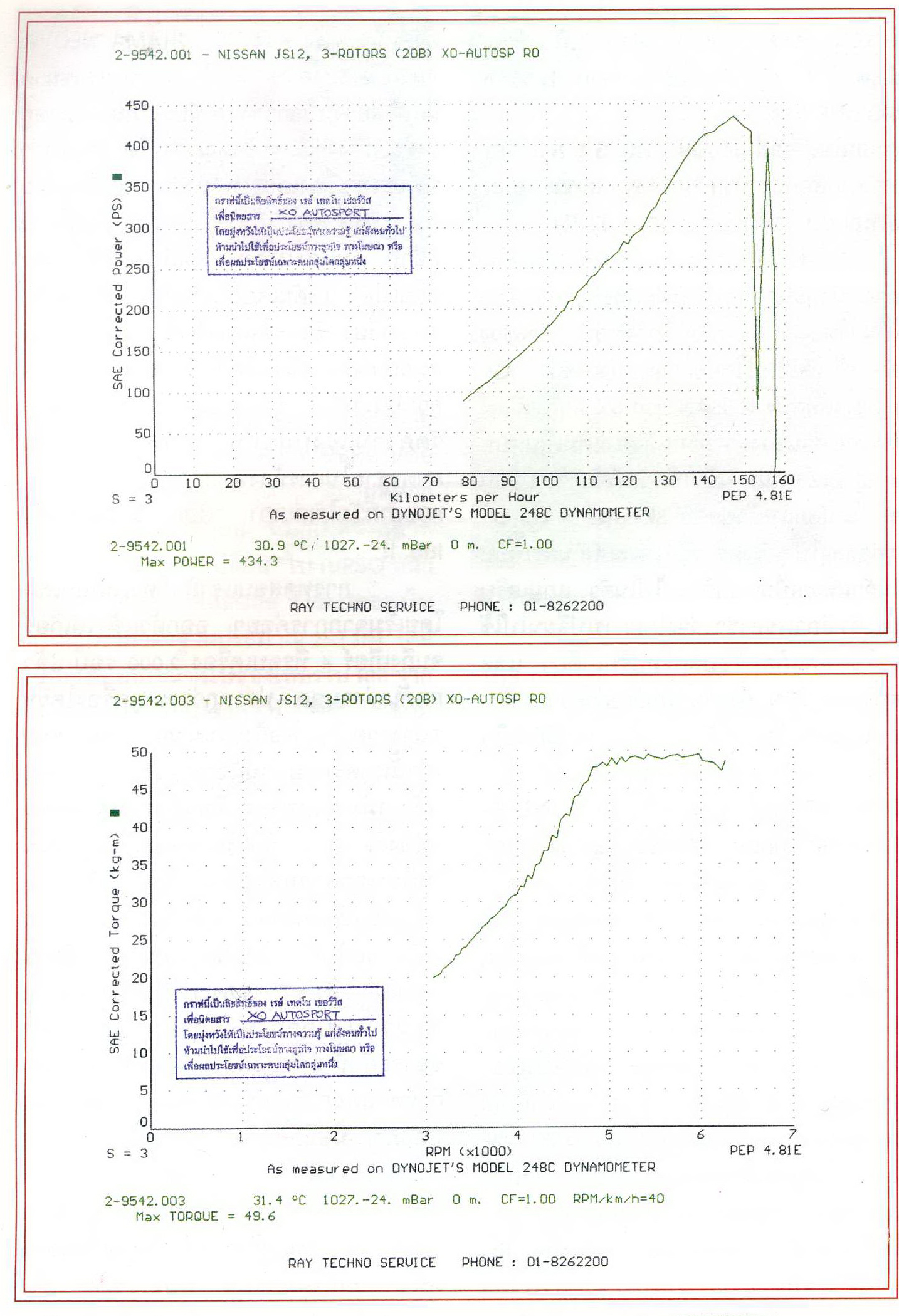
The measured horsepower was so shocking.. it was unbelievable!
The horsepower test was done the same way, starting with a slow acceleration to 4th gear at 2,000 rpm, then pressing the accelerator all the way down. The engine revved up rapidly, and around 3,000 rpm, it surged to its maximum, causing the ECU to cut out! The sound was exactly like a slipping clutch – the engine revving up like “revving in place,” indicating extraordinary power. To be sure, we tried again, and the result was the same. We suspected a “slipping clutch,” but when we saw the graph, the team was shocked! The sound that sounded like a slipping clutch was actually the engine running without the air conditioning and power steering pump to dampen it, allowing the engine to rev more smoothly. Combined with the powerful and rapid air compression from the giant turbocharger at a boost rate of only 0.8 bar, it can generate “434.3 PS” of horsepower. The horsepower curve starts at a speed of 78 kilometers per hour at approximately 2,000 rpm in 4th gear and slopes steeply at a 45-degree angle throughout, ending at 152 kilometers per hour before dropping straight down because the stock ECU cuts the engine speed to prevent damage. Notice that it can reach 152 kilometers per hour even in 4th gear, which is due to the aggressive gear ratio. The top speed is lower, but the acceleration is better. The measured torque is 49.6 kg-m at 5,900 rpm. Observing the torque graph, you can see that in the 3,000-4,800 rpm range, it has a steep slope similar to the horsepower graph, and then in the 4,800-6,300 rpm range, it is a straight line. This shows the turbocharger's power beginning to manifest at low rpm and being able to generate power continuously.
Real-world road testing revealed, “No tire burnout in all 3 gears!???”
This car was recently completed, so many things weren't quite ready yet. The gauges weren't fully functional, so the engine RPM wasn't displayed; only the boost gauge was working. Therefore, all we could do was sit back and observe the car's behavior. During the test, the driver started with relatively low RPMs and feathered the clutch, resulting in a smooth launch. Once the turbo started showing its power, it began to “slither” due to the tire burnout (no “free!” of charge!), but it wasn't too worrying. The driver managed to correct the “slithering” by constantly controlling the steering and throttle. In fact, there was no need to wait for the RPMs to build up. Around half a gear, the driver floored the throttle, and the engine roared out just like on the dyno. The test had to end just as the tires were burning rubber for the photos, because the police arrived…
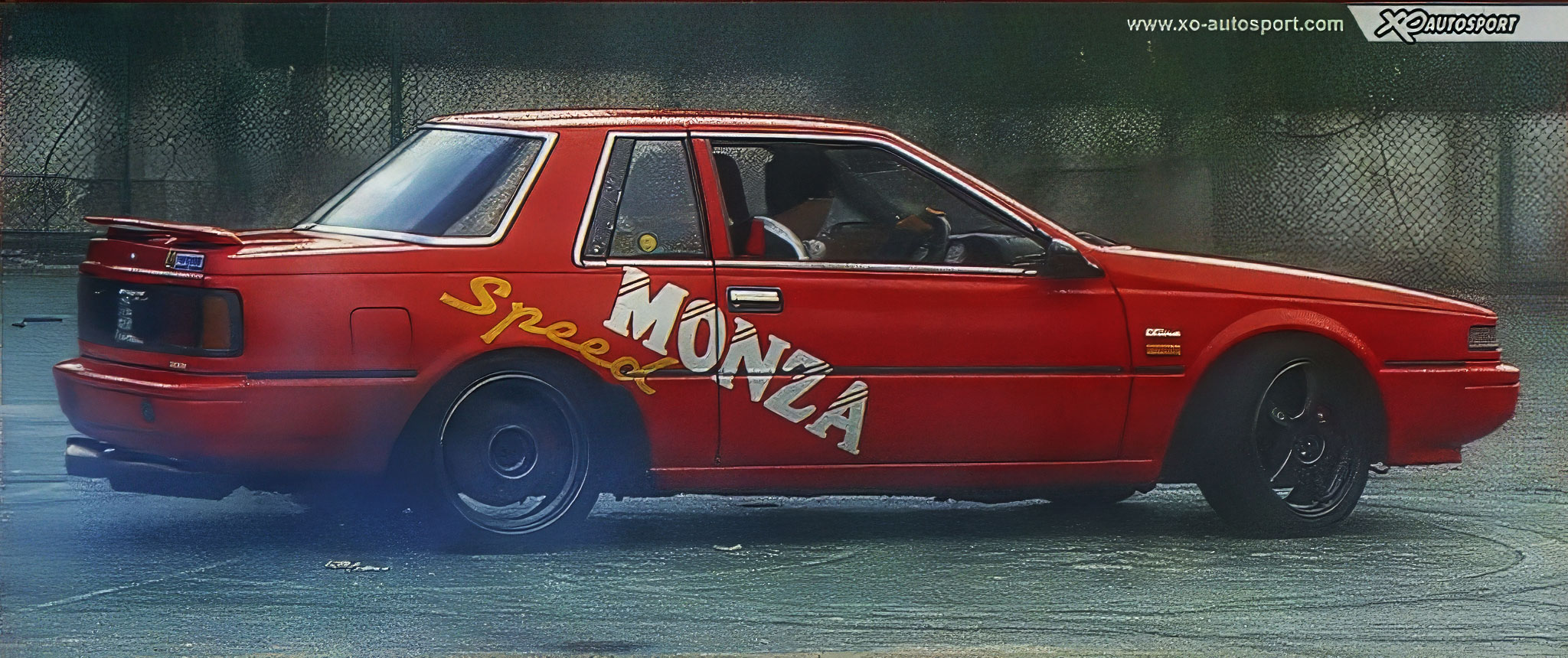
Overall, this car is good, but there are two downsides: it has way too much free-wheeling, and most importantly, it's incredibly hot! I was sweating profusely, but it was still fun. Finally, thank you to Khun Nueng for doing everything we asked to get the beautiful photos we wanted. Thank you to P' Ong from Ray Techno Service for testing the horsepower, and lastly, P' Tee for providing information on modifications.
Return to Editorial